Biology Escape Room
Review of Food Webs and Food Chains
Digital Escape Room Link
Saturday, April 13, 2019
Monday, February 4, 2019
Tuesday, January 29, 2019
January 29, 2019
ESSENTIAL QUESTION: What is the purpose of the Immune System?
LEARNING TARGET: Summarize the basic functions of the human immune system, vaccines, and antibiotics
BENCHMARKS: SC.912.L.14.52
LEARNING OBJECTIVES: Students will be able to:
-Summarize the basic functions of the human immune system.
-Compare and contrast types of infectious agents that may infect the human body.
BELL RINGER - EOC Focus Review: SC.912.L.14.36 Blood
Flow

VOCABULARY: antibiotics, antibody, antigen, allergy, cell-mediated immunity, B cells, T cells, chronic disease, communicable disease, humoral immunity, immune response, immune system, specific immunity, nonspecific immunity, infectious agent, pathogen, vaccines, fever, white blood cells, macrophages, histamines, antihistamines
HOME LEARNING: HL 2: Primary and secondary immune response

AGENDA
WHOLE GROUP
Students completed the bell ringer above.
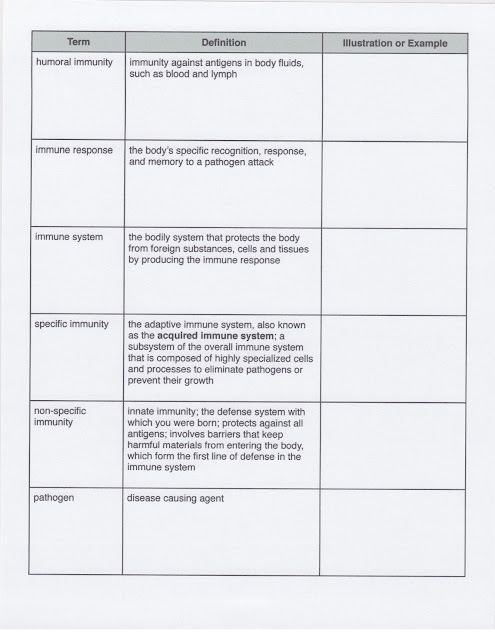
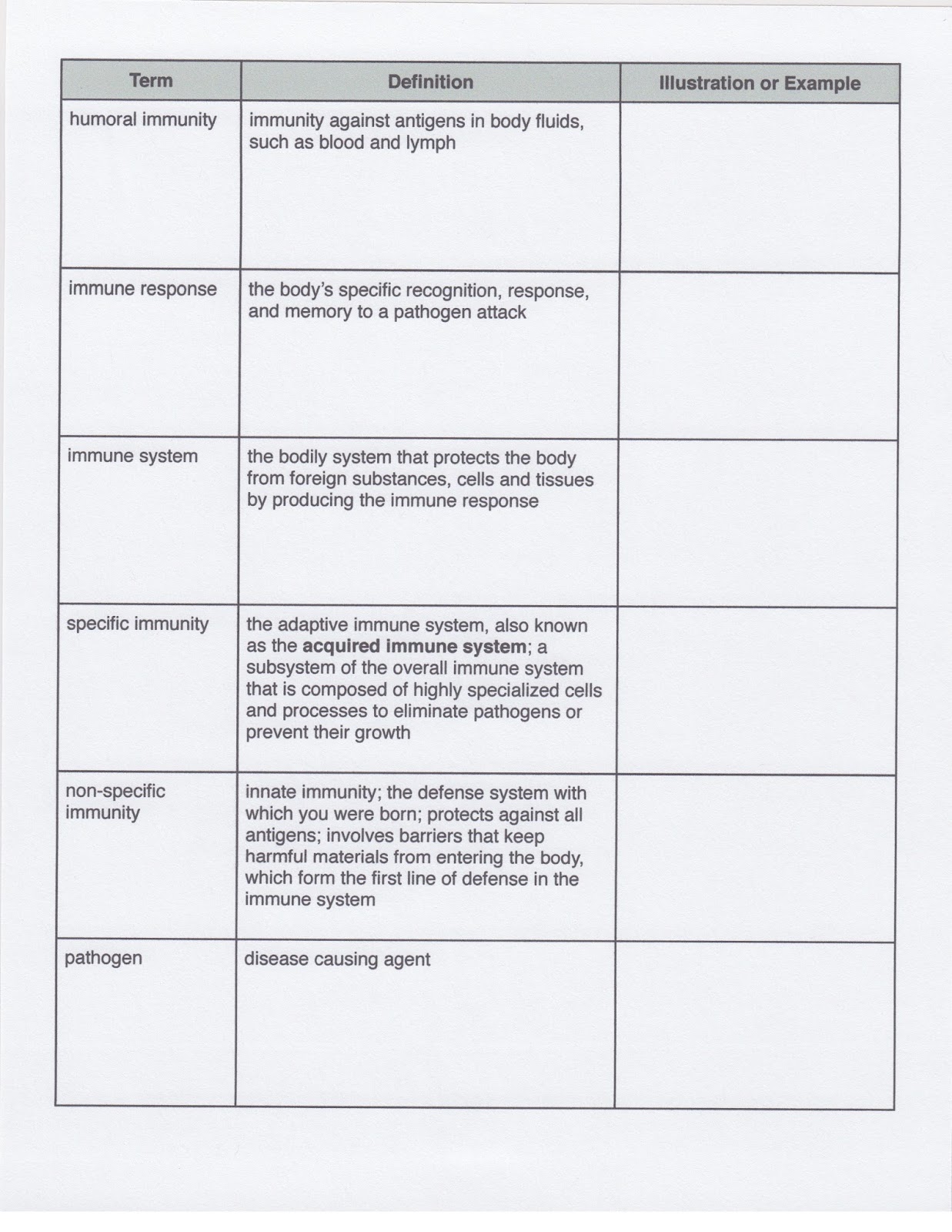
Students then received the vocabulary terms below. For each term, students should illustrate or write an example to help them remember the terms. Students also received Frayer word maps as home learning with specific words to map out.

Engage: Reflect on the following
A. What are some examples of organisms that cause disease?
B. What are some ways diseases are spread?
C. What are some ways we can prevent the spread of diseases?
D. Why do you think the human body makes a great place for disease causing organisms to grow?
E. In spite of being under constant attack by pathogens, we do not get sick all the time. What organ system is responsible for this?
-Explain to students that normally the body’s immune system protects them against
disease.
Video: Bob's Germs go to work



We then watched the video Bob's Germs Go To Work to introduce the topic of the Immune System. You can watch the film below.
Explore: GIZMO Pathogen spread
Explain: Notes - Immune System
You can find them below.
Evaluate: HL 2 Primary and secondary immune response
Exit Strategy: Write to explain why it is necessary to get your child immunized
H.O.T. QUESTIONS:
1. Why do you think is a beneficial adaptation for a pathogen to make its host very sick without killing the host? The pathogen often needs the host to stay alive for the pathogen to reproduce or replicate. A sick host is beneficial for the pathogen if some of the host’s behaviors, such as coughing and sneezing, helps spread the
pathogen.
2. Animals infected with the virus that causes rabies often salivate excessively and are apt to bite other animals even when unprovoked. How do these symptoms lead to the spread of the virus? The virus is probably present in the saliva. When an infected animal bites another animal, the pathogen in the infected animal’s saliva comes in contact with the bitten animal’s blood.
3. In what ways are symbiotic organisms that live on or in the human body similar to pathogens that make take up residence? How are they different? They are similar in that both require the human body to carry out their life cycles. They are different in that symbiotic organisms are generally harmless or may be beneficial to
humans, while pathogens cause diseases.
You can find them below.

Thursday, December 13, 2018
Tuesday, October 16, 2018
Thursday, May 10, 2018
Monday, December 18, 2017
Monday, 18 December through Friday, 22 December, 2017
NOTE: Due to Holiday Activities, class did not meet each day for for the entire class period on the days we did have class. Therefore some activities were not completed and will be completed next class period.

ESSENTIAL QUESTION: What is the purpose of the Immune System?
LEARNING TARGET: Summarize the basic functions of the human immune system, vaccines, and antibiotics
BENCHMARKS: SC.912.L.14.52
LEARNING OBJECTIVES: Students will be able to:
-Summarize the basic functions of the human immune system.
-Compare and contrast types of infectious agents that may infect the human body.
Bell Ringer: The diagram below represents possible evolutionary pathways of certain organisms.

Which species is most closely related to species L?
A. Species E
B. Species F
C. Species G
D. Species I
VOCABULARY: antibiotics, antibody, antigen, allergy, cell-mediated immunity, B cells, T cells, chronic disease, communicable disease, humoral immunity, immune response, immune system, specific immunity, nonspecific immunity, infectious agent, pathogen, vaccines, fever, white blood cells, macrophages, histamines, antihistamines
HOME LEARNING: notebook update
AGENDA
WHOLE GROUP
Students completed the bell ringer question and justified their answer.
Students then took notes on the immune system. The powerpoint movie of the notes is included below.
Thursday, December 14, 2017
Thursday, 14 December, 2017
ESSENTIAL QUESTION: What is the purpose of the Immune System?
LEARNING TARGET: Summarize the basic functions of the human immune system, vaccines, and antibiotics
BENCHMARKS: SC.912.L.14.52
LEARNING OBJECTIVES: Students will be able to:
-Summarize the basic functions of the human immune system.
-Compare and contrast types of infectious agents that may infect the human body.
-Take/Correct the QSBA 1 Exam
BELL RINGER - Study session
VOCABULARY: antibiotics, antibody, antigen, allergy, cell-mediated immunity, B cells, T cells, chronic disease, communicable disease, humoral immunity, immune response, immune system, specific immunity, nonspecific immunity, infectious agent, pathogen, vaccines, fever, white blood cells, macrophages, histamines, antihistamines
HOME LEARNING: notebook update
AGENDA
WHOLE GROUP
Due to the large number of people absent last class period, we held another study session for QSBA 1 Exam. Students made up the exam that were absent, while other students corrected their exams.
Once students completed the exam, students, we began notes on the immune system. We will complete the notes next class period.
Tuesday, December 12, 2017
Tuesday, 12 December, 2017
ESSENTIAL QUESTION: What is the purpose of the Immune System?
LEARNING TARGET: Summarize the basic functions of the human immune system, vaccines, and antibiotics
BENCHMARKS: SC.912.L.14.52
-Explain the basic functions of the human immune system, including specific and nonspecific immune response, vaccines, and antibiotics.
LEARNING OBJECTIVES: Students will be able to:
-Summarize the basic functions of the human immune system.
-Compare and contrast types of infectious agents that may infect the human body.
-Take the QSBA 1 Exam
BELL RINGER - Study session
VOCABULARY: antibiotics, antibody, antigen, allergy, cell-mediated immunity, B cells, T cells, chronic disease, communicable disease, humoral immunity, immune response, immune system, specific immunity, nonspecific immunity, infectious agent, pathogen, vaccines, fever, white blood cells, macrophages, histamines, antihistamines
HOME LEARNING: 2 Frayer model word maps
AGENDA
WHOLE GROUP
Students had a 10 minute study session for QSBA 1 exam as their bell ringer.
Vocabulary Freyer word maps were collected.
Students then did the exam on computer.
Friday, December 8, 2017
Friday, 8 December, 2017
ESSENTIAL QUESTION: What is the purpose of the Immune System?
LEARNING TARGET: Summarize the basic functions of the human immune system, vaccines, and antibiotics
BENCHMARKS: SC.912.L.14.52
LEARNING OBJECTIVES: Students will be able to:
-Summarize the basic functions of the human immune system.
-Compare and contrast types of infectious agents that may infect the human body.
-Data chat
BELL RINGER - Probe - catching a cold

VOCABULARY: antibiotics, antibody, antigen, allergy, cell-mediated immunity, B cells, T cells, chronic disease, communicable disease, humoral immunity, immune response, immune system, specific immunity, nonspecific immunity, infectious agent, pathogen, vaccines, fever, white blood cells, macrophages, histamines, antihistamines
HOME LEARNING: 2 Frayer model word maps
AGENDA
WHOLE GROUP
Students completed the bell ringer above, Catching a Cold.
Students then received the vocabulary terms below. For each term, students should illustrate or write an example to help them remember the terms. Students also received Frayer word maps as home learning with specific words to map out.
We then watched the video Bob's Germs Go To Work to introduce the topic of the Immune System. You can watch the film below.
We began taking notes, but did not complete the lesson. I will post the video of all the notes in both this and the next blog. You can find them below.
Wednesday, December 6, 2017
Wednesday, 6 December, 2017
ESSENTIAL QUESTION: What factors affect the functioning of the circulatory system?
LEARNING TARGET: Identify factors that affect blood flow and analyze how these factors affect blood flow through the cardiovascular system.
BENCHMARKS: SC.912.L.14.36
LEARNING OBJECTIVES: Students will be able to:
-identify and investigate the general functions of the circulatory system.
-Explain the factors that directly or indirectly affect blood flow.
-Data chat
BELL RINGER - Your doctor tells you that you have gestational hypertension. Write to explain what you could do to lover your blood pressure.
VOCABULARY: myocardium, artery, blood pressure, capillary, circulatory system, heart disease, heart, vein, cardiovascular system, stroke, cholesterol, plasma, viscosity, atrium, ventricle
HOME LEARNING: notebook update
AGENDA
WHOLE GROUP
Students wrote to explain the bell ringer above.
We completed the write up for the lab on blood flow and the heart.
Students were then assigned to groups to research each of the activity topics and report back to the class. Students then wrote as notes what each student shared. You can find the handouts below for this activity. Also, there is a picture of blood flow and the lab background to help you study for the next quiz.


Monday, December 4, 2017
Monday, 4 December, 2017
ESSENTIAL QUESTION: What factors affect the functioning of the circulatory system?
LEARNING TARGET: Identify factors that affect blood flow and analyze how these factors affect blood flow through the cardiovascular system.
BENCHMARKS: SC.912.L.14.36
LEARNING OBJECTIVES: Students will be able to:
-identify and investigate the general functions of the circulatory system.
-Explain the factors that directly or indirectly affect blood flow.
-Data chat
BELL RINGER - Answer and justify.

VOCABULARY: myocardium, artery, blood pressure, capillary, circulatory system, heart disease, heart, vein, cardiovascular system, stroke, cholesterol, plasma, viscosity, atrium, ventricle
HOME LEARNING: notebook update
AGENDA
WHOLE GROUP
Students answered and justified the bell ringer found above. The benchmark is SC.912.N.1.1 and the topic is The Nature of Science.
Students then returned and reviewed home learning 4.
We then reviewed the lab stations and then wrote the lab (on paper). For each station, students wrote the station number and title, the problem statement, copied and completed the data table, and answered the analysis questions. There were five stations in all.
We did not complete the activity, so will complete the last two next class.
Home learning is to complete activities 4 and 5 at home.
Sunday, December 3, 2017

Thursday, November 30, 2017
Thursday, 30 November, 2017
ESSENTIAL QUESTION: What factors affect the functioning of the circulatory system?
LEARNING TARGET: Identify factors that affect blood flow and analyze how these factors affect blood flow through the cardiovascular system.
BENCHMARKS: SC.912.L.14.36
LEARNING OBJECTIVES: Students will be able to:
-identify and investigate the general functions of the circulatory system.
-Explain the factors that directly or indirectly affect blood flow.
-Data chat
BELL RINGER - Answer and justify.
Which of the following is NOT true about the first living things?
a. The first living things may have used oxygen.
b. The first living things were prokaryotic.
c. The first living things were unicellular.
b. The first living things were prokaryotic.
c. The first living things were unicellular.
d. The first living things had a cell membrane.
VOCABULARY: myocardium, artery, blood pressure, capillary, circulatory system, heart disease, heart, vein, cardiovascular system, stroke, cholesterol, plasma, viscosity, atrium, ventricle
HOME LEARNING: HL 4 Functions of the circulatory system

AGENDA
WHOLE GROUP
Students answered and justified their answers to the above question for their bell ringer.
Home learning 4 was distributed and explained. As part of the lab, we reviewed the circulatory system. You can find the links below to review the information.
Students were assigned groups so that we could rotate through the 5 stations of the lab:
Station 1 - Blood Pressure and Blood Flow
Station 2 - Effect of Exercise on Blood Flow
Station 3 - Effect of Resistance on Blood Flow
Station 4 - Effect of Blood Viscosity on Blood Flow
Station 5 - Effect of Blood Volume on Blood Flow
We did not have time to write up the lab, but will conclude next class.
Subscribe to:
Posts (Atom)