Biology students should click one of the links below to access the NCBI source of information on Genes and Disease.
Blood and Lymph Diseases
Cancers
The Digestive System
Ear, Nose, and Throat
Diseases of the Eye
Female-Specific Diseases
Glands and Hormones
The Heart and Blood Vessels
Diseases of the Immune System
Male-Specific Diseases
Muscle and Bone
Neonatal Diseases
The Nervous System
Nutritional and Metabolic Diseases
Respiratory Disease
Skin and Connective Tissue
Once on the site, read the available information, then choose a specific disease from the list. Click the provided link to find information on the genetic disorder. Be sure to answer all the questions you were given.
Also choose two other non-listed sites to find additional facts about the disorder you've chosen. Follow all the other written instructions for the research paper.
Your paper should be printed out in black ink. If hand written, use blue or black ink and write on only one side of the paper.
Be sure to answer the following questions:
1. What is the name of the genetic disorder?
2. What system/part of the body does the disorder affect?
3. What gene an/or chromosome is mutated in this disorder?
4. What is the type of mutation that causes this disorder?
5. Is this mutation dominant or recessive?
6. What are the symptoms of this disorder?
7. What are the possible treatments for this disorder?
8. Does this disorder affect specific populations of people more so than other populations?
9. What is the percentage or ratio of the population suffering from this disorder?
10. Search the internet to find two reputable websites containing information about this disorder. Reputable websites end in .edu, .gov., or .org. For each website, write the website address, the name of the website, and two facts about this disorder that are different from those above.
Remember, the finished project is due in class on March 17/18.
Thursday, February 19, 2015
Tuesday, January 20, 2015
Tuesday/Wednesday, 20/21 January, 2015
ESSENTIAL QUESTION: How can populations evolve to form new species?
NGSSS: SC.912.L.15.13; SC.912.L.15.15; A.912.L.15.15
BENCHMARKS:
-Describe the conditions required for natural selection, including: overproduction of offspring, inherited variation, and the struggle to survive, which result in differential reproductive success. -Discuss mechanisms of evolutionary change other than natural selection such as genetic drift and gene flow.- Describe how mutation and genetic recombination increase genetic variation.
LEARNING OBJECTIVES: Students will be able to:
-identify the conditions required for natural selection.
-relate the conditions required for natural selection to differential reproductive successes.
-recognize some of the scientific mechanisms resulting in evolutionary change.
BELL RINGER: Answer the questions on the handout. Place the completed handout in your notebook. You will use the handout to enter your answers using the CPS clicker system. I apologize that I am not able t add the handout to this lesson. My regular computer is down and I cannot access my scanner to scan in the appropriate handout.
VOCABULARY: adaptation, adaptive radiation, ancestor, artificial selection, bottleneck, coevolution, convergent evolution, directional selection, disruptive selection, evolution, extinction
HOME LEARNING: Study for Mid-year Biology Exam
Students completed the handout and reviewed the information, which will help prepare you for the Winter interim assessment in biology, to be given next week.
We then completed the questions from the Peppered Moth Simulation. You can find the activity on Dr. Gayden's Science Zone. Next class, we will do the actual experiment.

Wednesday, January 14, 2015
Wednesday/Thursday, 14/15 January, 2015
ESSENTIAL QUESTION: How can populations evolve to form new species?
NGSSS: SC.912.L.15.13; SC.912.L.15.15; A.912.L.15.15
BENCHMARKS:
-Describe the conditions required for natural selection, including: overproduction of offspring, inherited variation, and the struggle to survive, which result in differential reproductive success. -Discuss mechanisms of evolutionary change other than natural selection such as genetic drift and gene flow.- Describe how mutation and genetic recombination increase genetic variation.
LEARNING OBJECTIVES: Students will be able to:
-identify the conditions required for natural selection.
-relate the conditions required for natural selection to differential reproductive successes.
-recognize some of the scientific mechanisms resulting in evolutionary change.
BELL RINGER: Complete the formative assessment Habitat Change by choosing the statement(s) you believe to be correct and explain your answer. This will go in the center of your Cornell notes. Period 3 has already completed this activity and Period 2 has not yet done so, due to testing on Tuesday.
 |
| This is your bell ringer. Once you make a new Cornell notes page (be sure to add the date, benchmark and essential question to your table of contents), paste this in the center of the Cornell notes. |
VOCABULARY: adaptation, adaptive radiation, ancestor, artificial selection, bottleneck, coevolution, convergent evolution, directional selection, disruptive selection, evolution, extinction
HOME LEARNING: Study for Mid-year Biology Exam
Students completed the bell ringer (see above and shared their answers in class). This is directed towards period 2 only, as period 3 has already completed this activity. The page should be pasted to the inside of the Cornell notes.
Today, period 1 students participated in the deflasking of the orchids for the Million Orchid Project with Fairchild Gardens. All remaining activities are for period 2 students.
Students viewed a BrainPop on Natural Selection. You can watch it at the link Natural Selection.
We then, as a class, completed the Peppered Moth Simulation. Click the link to access the activity. Be sure to answer all questions in your interactive notebook.
Monday, January 12, 2015
Monday/Tuesday, 12/13 January, 2015
ESSENTIAL QUESTION: How can populations evolve to form new species?
NGSSS: SC.912.L.15.13; SC.912.L.15.15; A.912.L.15.15
BENCHMARKS:
-Describe the conditions required for natural selection, including: overproduction of offspring, inherited variation, and the struggle to survive, which result in differential reproductive success. -Discuss mechanisms of evolutionary change other than natural selection such as genetic drift and gene flow.- Describe how mutation and genetic recombination increase genetic variation.
LEARNING OBJECTIVES: Students will be able to:
-identify the conditions required for natural selection.
-relate the conditions required for natural selection to differential reproductive successes.
-recognize some of the scientific mechanisms resulting in evolutionary change.
BELL RINGER: Complete the formative assessment Habitat Change by choosing the statement(s) you believe to be correct and explain your answer. This will go in the center of your Cornell notes.
|
| This is your bell ringer. Once you make a new Cornell notes page (be sure to add the date, benchmark and essential question to your table of contents), paste this in the center of the Cornell notes. |
VOCABULARY: adaptation, adaptive radiation, ancestor, artificial selection, bottleneck, coevolution, convergent evolution, directional selection, disruptive selection, evolution, extinction
HOME LEARNING: Study for Mid-year Biology Exam
Students completed the bell ringer (see above and shared their answers in class).
Students submitted and reviewed HL 8.
Students viewed a BrainPop on Natural Selection. You can watch it at the link Natural Selection.
We then, as a class, completed the Peppered Moth Simulation. Click the link to access the activity. Be sure to answer all questions in your interactive notebook.
We did not complete the entire activity, and will do so at a later date.
Remember, all work must be submitted by Wednesday of this week.
Thursday, January 8, 2015
Thursday/Friday, 08/09 January, 2015
ESSENTIAL QUESTION: What evidence supports the Theory of Evolution?
NGSSS: SC.912.L.15.1
BENCHMARKS:
-Explain how the scientific theory of evolution is supported by the fossil record, comparative anatomy, comparative embryology, biogeography, molecular biology, and observed evolutionary change.
LEARNING OBJECTIVES: Students will be able to:
-identify bodies of evidence that support the scientific theory of evolution.
BELL RINGER: Write to explain how fossils are used to support the Theory of Evolution. Use an example.
VOCABULARY: evolution, fossil, artificial selection, adaptation, fitness, natural selection, biogeography, homologous structure, analogous structure, vestigial structure, the struggle for existance
HOME LEARNING: HL 8, on your own paper/work on your science fair paper/project
Students completed the bell ringer, sharing out answers with the class.
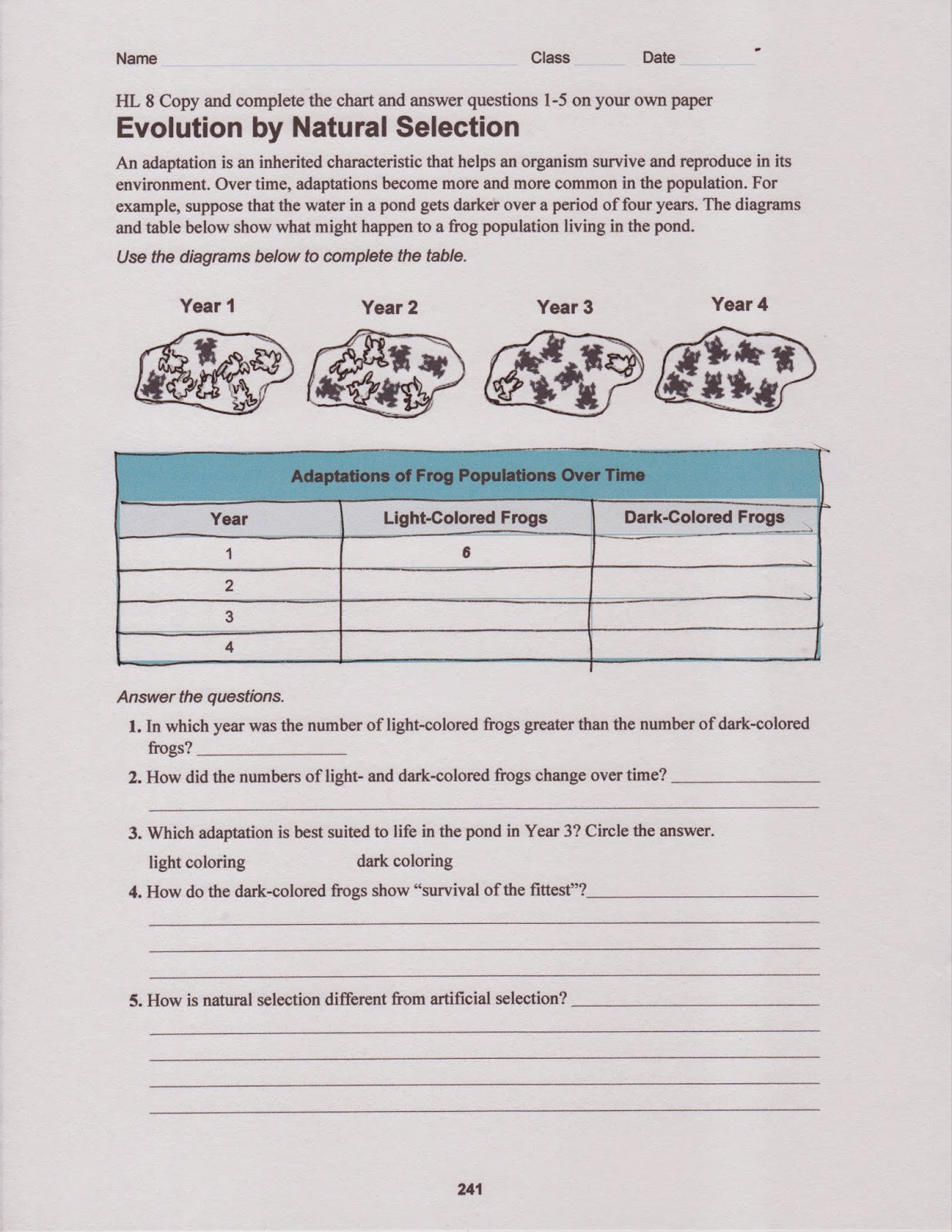 |
| Copy the chart. Answer the questions, all on your own paper. Place this page in your notebook.
Students also reviewed HL 7 and received HL 8, which can be found below. Remember to answer all questions on your own paper. You must copy and complete the chart, as well as answer the questions. Place the handout in your interactive notebook.
We completed the notes from the powerpoint (found on My Big Campus as a power point and on this site as a movie). Be sure to now place all handouts in your notebook, write your three leveled Costa questions, highlight questions and answers, and write a lesson summary on your Cornell notes page.
We also completed the chapter mystery handout (see below).
|
 |
| Complete and place in notebook. |
Students completed an exit slip on evolution.
Remember the last day to submit projects in Monday!
Tuesday, January 6, 2015
Tuesday/Wednesday, 06/07 January, 2015
ESSENTIAL QUESTION: What evidence supports the Theory of Evolution?
NGSSS: SC.912.L.15.1
BENCHMARKS:
-Explain how the scientific theory of evolution is supported by the fossil record, comparative anatomy, comparative embryology, biogeography, molecular biology, and observed evolutionary change.
LEARNING OBJECTIVES: Students will be able to:
-identify bodies of evidence that support the scientific theory of evolution.
BELL RINGER: Complete the concept map of the handout.
VOCABULARY: evolution, fossil, artificial selection, adaptation, fitness, natural selection, biogeography, homologous structure, analogous structure, vestigial structure, the struggle for existance
HOME LEARNING: HL 7, on your own paper/work on your science fair paper/project
Students completed the concept map, based on their reading about evidence for evolution from the text. The handout also includes HL 7. HL 7 is to be answered on your own paper. You will place the handout in your notebook.
 |
| The concept map is to be completed for today's bell ringer. HL 7 is to answer questions 1-6 on your own paper, answers only. The lesson recap should help you distinguish between natural and artificial selection.
Students then took note about Darwin and evolution. You can find a shortened movie of the power point below. The entire powerpoint can be found at My Big Campus. Due to uploading restriction, only a shortened version of the power point, in movie form, is found below. It omits many of the interesting background information. Be sure that even though you take notes from this presentation (what's in red), you take the time to go through the original, albeit long power point presentation.
We will complete the notes next class.
Remember, projects are due in class on Monday!
Home learning 7 is due next class session!
|
Friday, December 19, 2014
Friday, 19 December, 2014 and Monday, 5 January, 2015
ESSENTIAL QUESTION: What evidence supports the Theory of Evolution?
NGSSS: SC.912.L.15.1
BENCHMARKS:
-Explain how the scientific theory of evolution is supported by the fossil record, comparative anatomy, comparative embryology, biogeography, molecular biology, and observed evolutionary change.
LEARNING OBJECTIVES: Students will be able to:
-identify bodies of evidence that support the scientific theory of evolution.
BELL RINGER: Complete the biogeography handout found below. Place the completed handout in your interactive notebook.
 |
| This is your bellringer. Place the handout and the answers in your notebook. |
VOCABULARY: evolution, fossil, artificial selection, adaptation, fitness, natural selection, biogeography, homologous structure, analogous structure, vestigial structure, the struggle for existance
HOME LEARNING: work on your science fair paper/project
After completing and reviewing the bell ringer, we reviewed home learning 6. All handouts should be placed in your notebook.
WE then watched a Bill Nye clip on Evolution, completing a Stop and Jot sticky as we viewed the video. You need to write only one fact from the video.

| ||
We will complete the lesson on evolution when we return from Christmas break.
Have a Merry Christmas!
|

Subscribe to:
Posts (Atom)