Monday, November 30, 2015

Monday, 30 November and Tuesday, 01 December, 2015

ESSENTIAL QUESTION: What evidence supports the idea that life on earth can change?  

RELEVANCE: Prove it to me! 

NGSSS: SC.912.L.15.1; MAFS.912.N-Q.1.1; LAFS.910.SL.1.1

LEARNING OBJECTIVES:  Students will be able to:
-Identify bodies of evidence that support the scientific theory of evolution.
-Recognize anatomical similarities such as homologous structures and vestigial organs when referring to comparative anatomy and comparative embryology.

BELL RINGER - Macromolecules review (see dropbox)

VOCABULARY: biogeography, brain stem, cerebellum, cerebrum, comparative anatomy

HOME LEARNING: notebook update

AGENDA
WHOLE GROUP

WE reviewed interdisciplinary connections with ELA and other subjects as it relates to our studies. Today, we will continue with making inferences and comparing and contrasting.

We continued explaining how scientists use proof from information gathered by biogeography, molecular biology, fossils, homologous structures and analogous structures to support the theory of evolution.

SMALL GROUP/INDEPENDENT PRACTICE/DI
Students who complete work early should to to Edgenuity and work on the topics they received less than 70% from the last exam

HOTS: 
-Which method of evidence for evolution is the strongest? Why do you think so?
-How might the fossil record mislead someone in trying to create evolutionary ties between two species/organisms?

EXIT STRATEGY: 

Molecular Biology Summary Question.

Saturday, November 28, 2015

Monday, November 23, 2015

Monday/Tuesday, 23/24 November, 2015

ESSENTIAL QUESTION: What evidence supports the idea that life on earth can change?  

RELEVANCE: Prove it to me! 

NGSSS: SC.912.L.15.1; MAFS.912.N-Q.1.1; LAFS.910.SL.1.1

LEARNING OBJECTIVES:  Students will be able to:
-Identify bodies of evidence that support the scientific theory of evolution.
-Recognize anatomical similarities such as homologous structures and vestigial organs when referring to comparative anatomy and comparative embryology.

BELL RINGER - Human Evolution - Comparing Primates-Comparative Anatomy part One/Part Two

VOCABULARY: biogeography, brain stem, cerebellum, cerebrum, comparative anatomy

HOME LEARNING: notebook update

AGENDA
WHOLE GROUP

We reviewed our connections with other classes. Our inference coincides with what is being done in Language Arts and History.

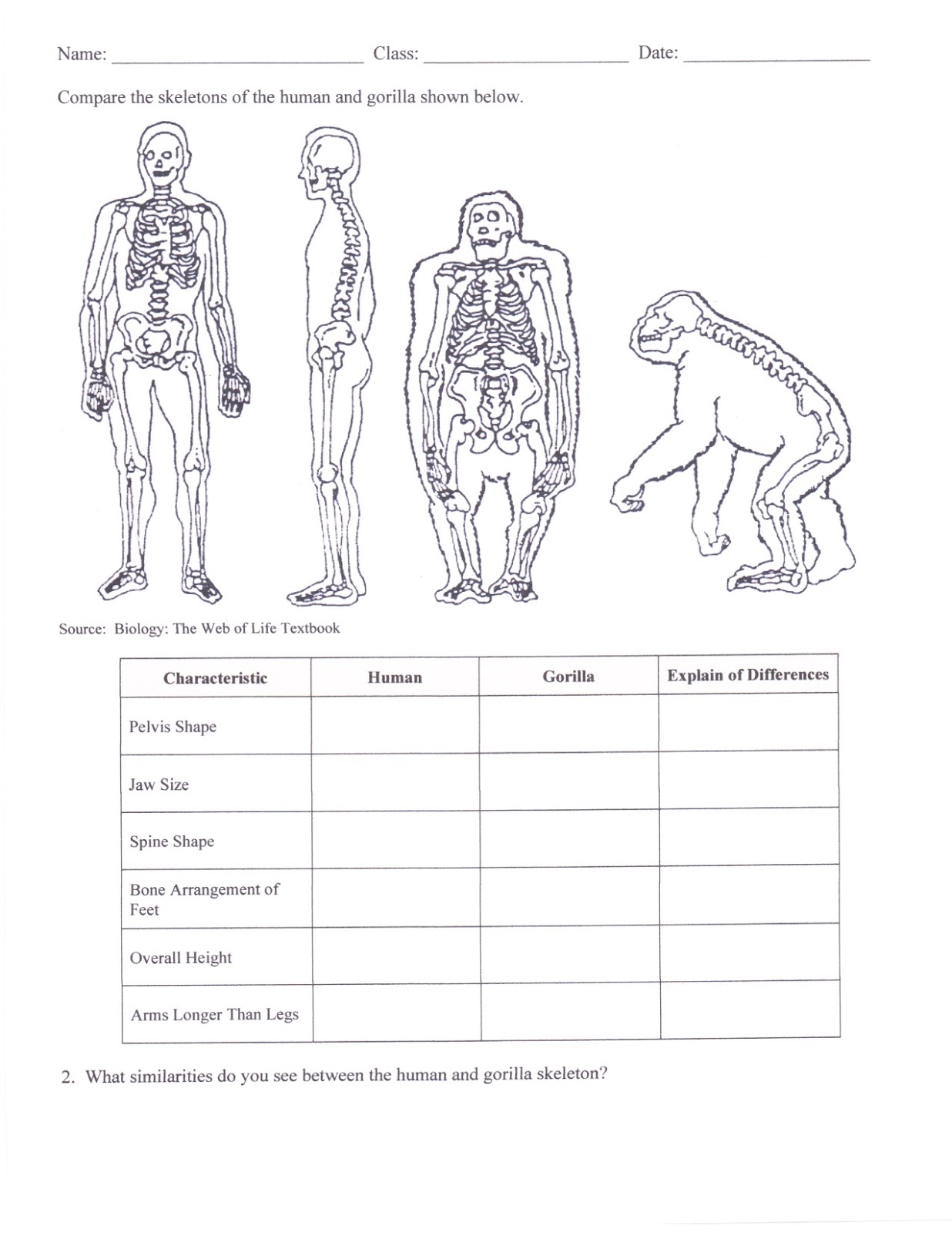
The bell ringer was to do the comparative anatomy comparisons for the Primates. You can find it on the handouts listed in pst blogs.

Students received the vocabulary lists and used them to make a Frayer Model of one of the terms. You can find the vocabulary list below.
This should be completed and placed in your interactive notebook.


We continued our discussion on how scientists use evidence and clues to determine how organisms have changed over time. Today, we dealt with molecular biology and embryology. We have already concluded that looking at homologous structures is one method by which scientists establish evolution.

The exit slip is to complete and submit the final molecular biology activity from the package. Period 6 will do this next week.

SMALL GROUP/INDEPENDENT PRACTICE/DI
Students who complete work early should to to Edgenuity and work on the topics they received less than 70% from the last exam

HOTS: 
-Which method of evidence for evolution is the strongest? Why do you think so?
-How might the fossil record mislead someone in trying to create evolutionary ties between two species/organisms?

EXIT STRATEGY: 

Molecular Biology Summary Question.

Thursday, November 19, 2015

Thursday/Friday, 19/20 November, 2015

ESSENTIAL QUESTION: What evidence supports the idea that life on earth can change?  

RELEVANCE: Prove it to me! 

NGSSS: SC.912.L.15.1; MAFS.912.N-Q.1.1; LAFS.910.SL.1.1

LEARNING OBJECTIVES:  Students will be able to:
-Identify bodies of evidence that support the scientific theory of evolution.
-Recognize anatomical similarities such as homologous structures and vestigial organs when referring to comparative anatomy and comparative embryology.

BELL RINGER - Human Evolution - Comparing Primates-Comparative Anatomy part One/Part Two

VOCABULARY: biogeography, brain stem, cerebellum, cerebrum, comparative anatomy

HOME LEARNING: notebook update

AGENDA
WHOLE GROUP

We reviewed interdisciplinary connections and related them to current ELA benchmarks and other topics.

The bell ringer was to complete the comparing primates comparative anatomy part one section of the handouts. All handouts will be listed below.

We then collected and reviewed the home learning.

We related various methods by which scientists can confirm the theory of evolution, using the remainder of the packet. We did not complete our studies and will do so next class session. 

All handouts can be found below.


Use this page as your bell ringer. Measure the thumbs from the to of the thumb (left appendage) to the base of the wrist for consistency.


SMALL GROUP/INDEPENDENT PRACTICE/DI
Students who complete work early should to to Edgenuity and work on the topics they received less than 70% from the last exam

HOTS: 
-Which method of evidence for evolution is the strongest? Why do you think so?
-How might the fossil record mislead someone in trying to create evolutionary ties between two species/organisms?

EXIT STRATEGY: 

Molecular Biology Summary Question.

Tuesday, November 17, 2015

Tuesday/Wednesday, 17/18 November, 2015

ESSENTIAL QUESTION: What evidence supports the idea that life on earth can change?  

RELEVANCE: Can monkey see, then do? 

NGSSS: SC.912.L.15.1; MAFS.912.N-Q.1.1; LAFS.910.SL.1.1

LEARNING OBJECTIVES:  Students will be able to:
-Identify bodies of evidence that support the scientific theory of evolution.
-Recognize anatomical similarities such as homologous structures and vestigial organs when referring to comparative anatomy and comparative embryology.
-Identify basic trends in hominid evolution.
-Set up the second trial for Journey To Mars (P5)

BELL RINGER - Complete the chart.

VOCABULARY: biogeography, brain stem, cerebellum, cerebrum, comparative anatomy

HOME LEARNING: HL 3

AGENDA
WHOLE GROUP

We first reviewed the interdisciplinary connections with ELA and other subjects.

The bell ringer was to complete the chart, using the diagrams. Choose to determine if each statement is an inference or direct evidence. You can find the handout below.

This is your bell ringer. Complete and place in your interactive notebook.

Home learning 3 was distributed and explained. You can find the handout below. If you make your writing dark, I will make a copy for you. There is no need to rewrite the entire handout. Also, be sure to answer the questions using complete sentences.

This is HL 3. Answer the questions using complete sentences.


Students then continued the becoming human activity, completing the final comparison and questions.

Period 5 set up the second trial for the Journey to Mars study with Fairchild Gardens.

Friday, November 13, 2015

Friday/Monday, 13/16 November, 2015

ESSENTIAL QUESTION: What evidence supports the idea that lie on earth can change?  

RELEVANCE: Can monkey see, then do? 

NGSSS: SC.912.L.15.1; MAFS.912.N-Q.1.1; LAFS.910.SL.1.1

LEARNING OBJECTIVES:  Students will be able to:
-Identify bodies of evidence that support the scientific theory of evolution.
-Recognize anatomical similarities such as homologous structures and vestigial organs when referring to comparative anatomy and comparative embryology.
-Identify basic trends in hominid evolution.

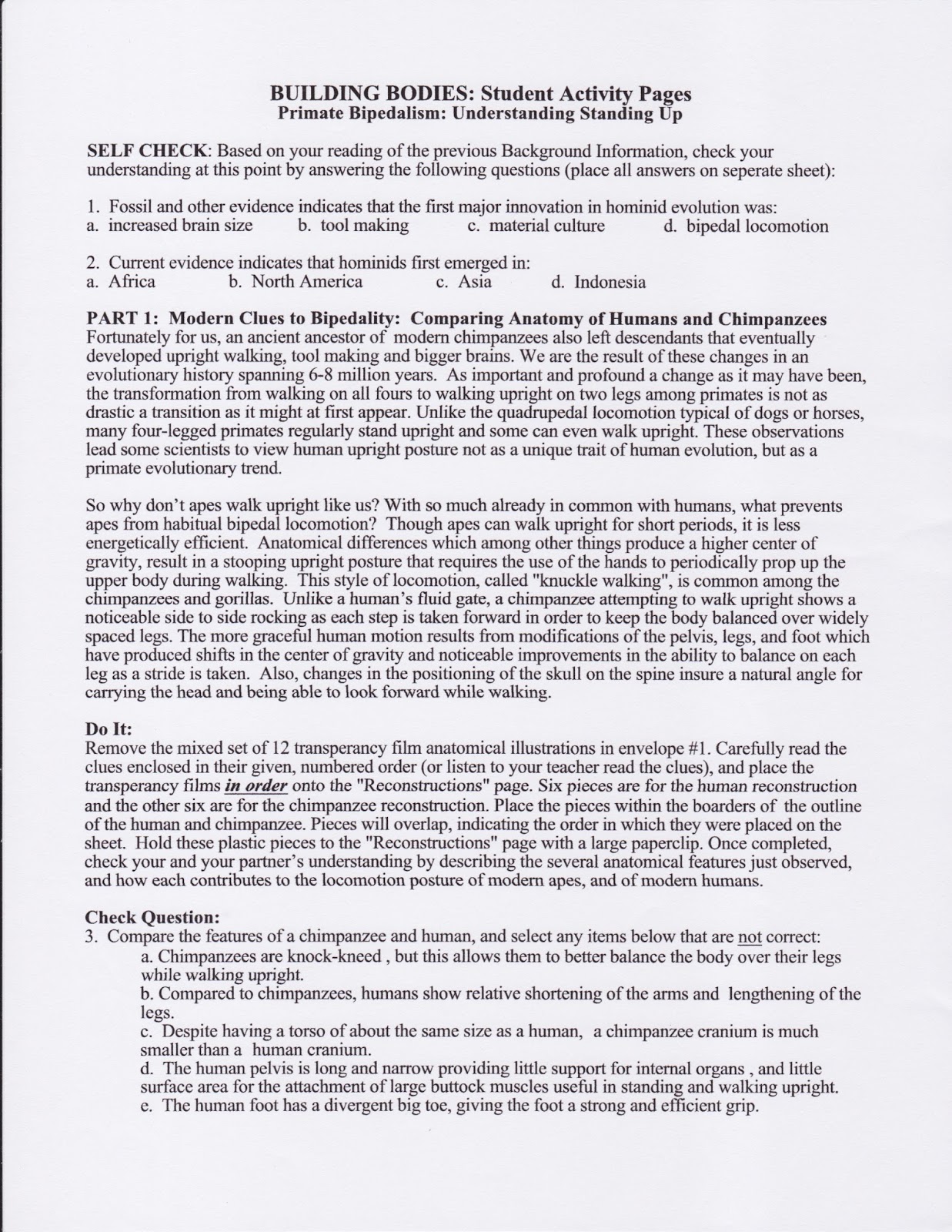
BELL RINGER - Read the background information and answer the questions (1-2).

VOCABULARY: biogeography, brain stem, cerebellum, cerebrum, comparative anatomy

HOME LEARNING: notebook update

AGENDA
WHOLE GROUP

We reviewed the interdisciplinary connections with ELA and other subjects.

The bell ringer was to read the background information and answer the two questions on page 2.

CERs from the invasive species activity were collected.

We introduced the comparative anatomy lesson with a discussion of the saying, monkey see, monkey do.

We then watched a BrainPop movie on Human Evolution, completing a fact vs myth page. You can find the page below.
This is the handout to use as you watch the BrainPop video on Human Evolution.


You can watch the video by clicking the link Human Evolution an use the username and password palmbeach.

We discussed the difference between a theory and a law. We then discussed the theory of evolution and why it is considered a theory.

We then did activities one and two from the package Becoming Humans. You can find the handouts below.


These handouts can be used to complete the first tasks of comparing humans and chimps.


Activities will be completed next class if not done so today.

SMALL GROUP/INDEPENDENT PRACTICE/DI
Students who complete work early should to to Edgenuity and work on the topics they received less than 70% from the last exam

HOTS: 
-What evidence supports the idea that humans and chimps are related?
-What evidence discredits the theory that humans and chimps are related?

EXIT STRATEGY: 

completed questions from activity.

Tuesday, November 10, 2015

Tuesday/Thursday, 10/12 November, 2015

ESSENTIAL QUESTION: What causes populations to change? 

RELEVANCE: Is immigration really that bad? 

NGSSS: SC.912.L.17.5; MAFS.912.N-Q.1.1; LAFS.910.SL.1.1

LEARNING OBJECTIVES:  Students will be able to:
-Utilize data and information about population dynamics, abiotic factors, and/or biotic factors to explain and/or analyze a change in carrying capacity and its effect on population size in an ecosystem.
-Compare the different types of growth in a species population.
-Identify limiting factors and other population dynamics.

BELL RINGER - Why might the sheep population change over time?

VOCABULARY: population, limiting factors, carrying capacity, competition, density, emigration, immigration

HOME LEARNING: HL 2 - CER from invasive species lesson

AGENDA
WHOLE GROUP

Students answered the bell ringer based on their knowledge of what causes populations to change.

We reviewed the information from the video and the article so that students can write an informed CER on the two reliable sources. Students were instructed to use their planning sheet to write cohesive answers for each section.

We examined how changing different parameters affected the population of sheet, using the following site: Population Explosion. Students should read each scenario and follow the instructions.

Finally, students should try the math-related activity to learn how exponential growth works. These real-world situations should interest anyone who wishes to multiply their money! Click the link to try it! Compound Interest

SMALL GROUP/INDEPENDENT PRACTICE/DI
Students who complete work early should to to Edgenuity and work on the topics they received less than 70% from the last exam

HOTS: 
-What factors are causing a change in the population of the Everglades? Are these factors reversible?  Why or why not?
-Describe the factors that would limit the carrying capacity of the Florida Everglades.

EXIT STRATEGY: 

Answer the following via discussion:
1. Many animals – for example, mosquitoes and fish – may lay thousands of eggs in one year.
Why might this be a good survival strategy? Why don’t they take over the world?
2. For some animals, as the population gets denser, the reproduction rate goes down. For example, mice reduce the size of their litter if the food supply is limited. Why would this be useful?